opamp-core
Provider Server Diagrams Guide
This page explains the rendered provider/server diagrams and links each one back to Mermaid source and related docs.
Source and Related Docs
- Mermaid source: docs/dev/server(provider)/provider_server_diagram.md
- Provider endpoint inventory: docs/endpoints.md
- Provider auth setup and token modes: docs/authentication.md
- Command queue and payload internals: docs/dev/command_process_implementation_note.md
- Mixin design reference (consumer-side pattern): docs/dev/client(consumer)/consumer_mixins.md
Diagram 1: Class and Module Relationships
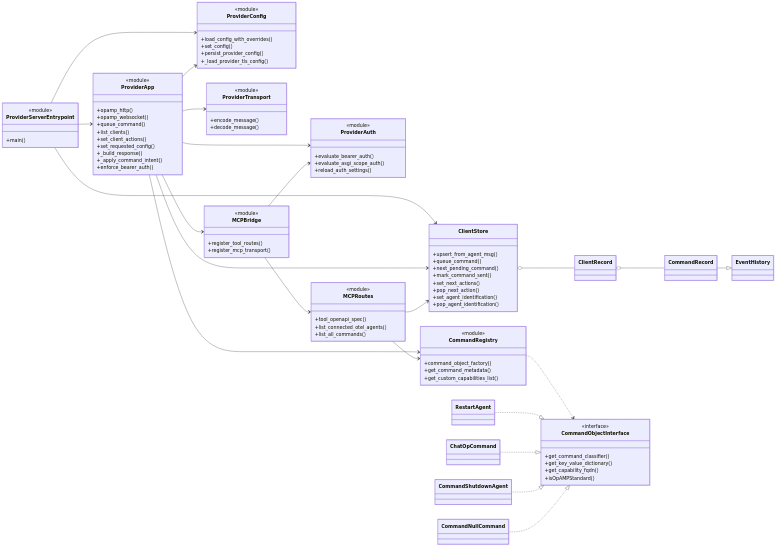
What this shows:
server.pybootstraps config and starts Quart.app.pyowns OpAMP transport handlers, REST/UI endpoints, and response building.state.py(STORE) is the in-memory source of truth for client records and queued commands.commands.pyand command implementation classes build command/custom payload shapes.mcptoolroute and transport bridge modules expose MCP and integrate auth checks for MCP ASGI traffic.
Diagram 2: Runtime Entrypoints and Transport
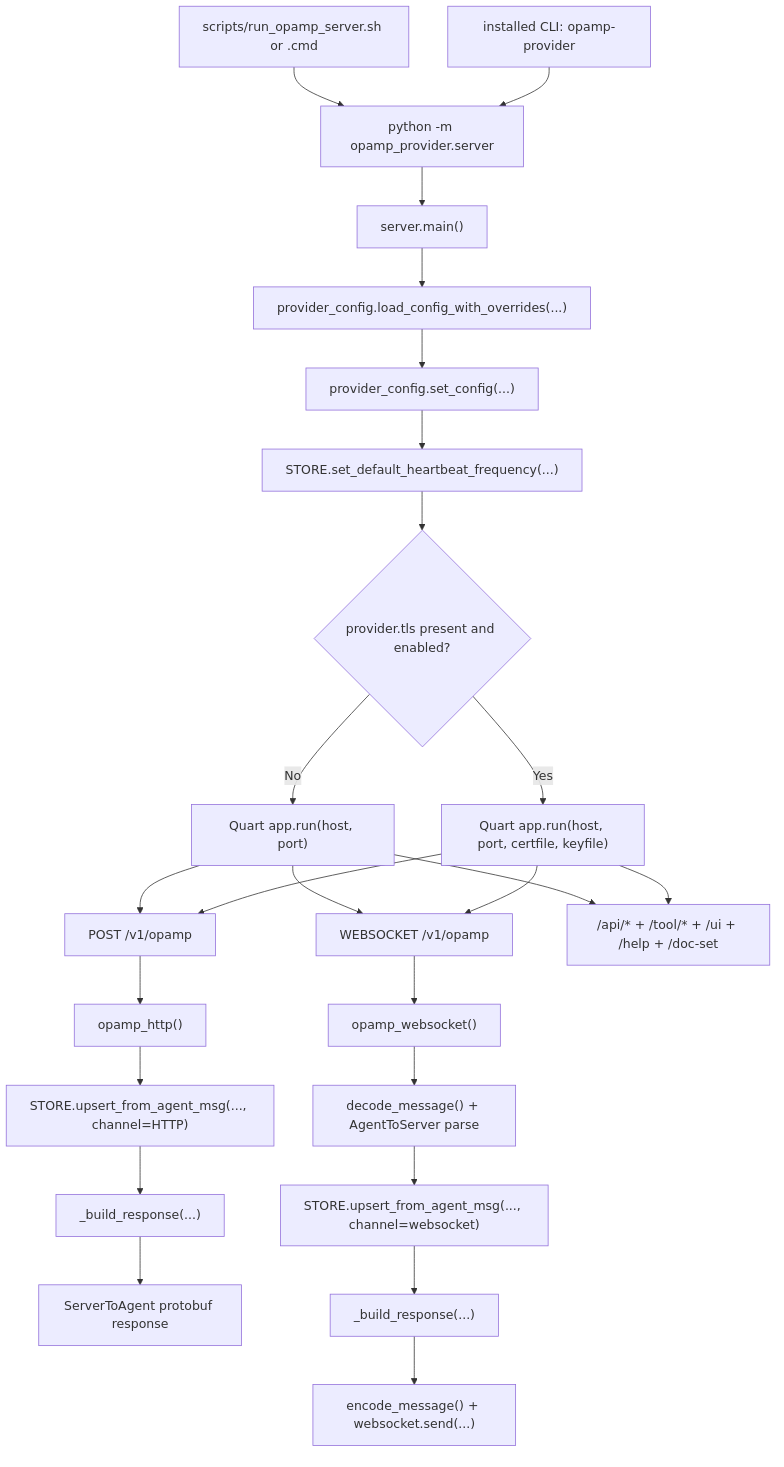
What this shows:
- Script/CLI entrypoints into
opamp_provider.server. - Startup path through config load, store defaults, and
app.run(...). - Conditional startup mode:
- HTTP when
provider.tlsis absent, or whenprovider.tls.enabled=false. - HTTPS when
provider.tlsis present and enabled withprovider.tls.cert_fileandprovider.tls.key_fileconfigured.
- HTTP when
- Parallel request surfaces: OpAMP HTTP, OpAMP WebSocket, and REST/UI/tool APIs.
Diagram 3: Command Queue and Dispatch Pipeline
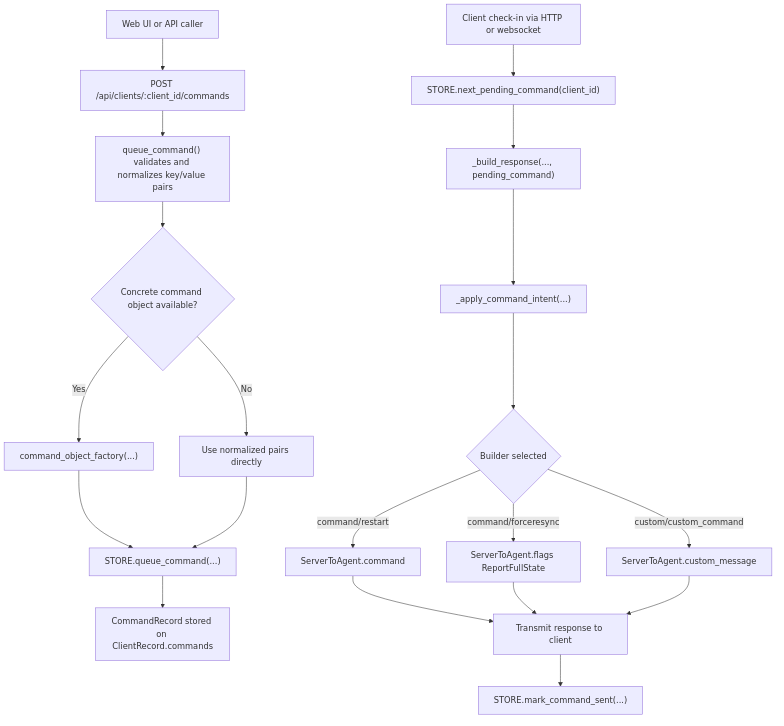
What this shows:
- How
/api/clients/<client_id>/commandsnormalizes input and queuesCommandRecordentries. - Where command object factories are used for concrete command types.
- How pending commands are consumed on the next client check-in and encoded as:
ServerToAgent.commandServerToAgent.custom_message- or
ServerToAgent.flags(full-state resync)
- How sent commands are marked complete in store state.
Diagram 4: Auth and MCP Transport Routing
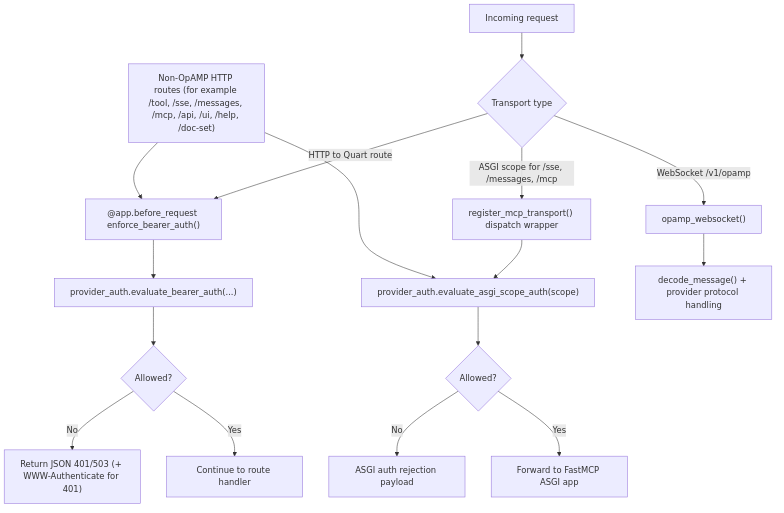
What this shows:
- HTTP route protection via
@app.before_requestandevaluate_bearer_auth(...). - MCP ASGI protection via
register_mcp_transport(...)wrapper andevaluate_asgi_scope_auth(...). - The difference between protected MCP/tool paths and the protocol handling path for
/v1/opampWebSocket.